School of the Ancients
Ask a question. Create an exhibit. Explore the answer with a teacher in your room.
A question becomes something you can explore.
Ask a historically inspired teacher a question, request an exhibit, then explore the result in your room. School of the Ancients connects an ongoing learning conversation to Blender authoring and a shared Three.js/WebXR world on Quest 3.
Each demonstration starts in a blank world. The exhibits are created and loaded on demand in response to the learner’s request. The application also supports reusable avatars and assets; the video combines recorded sessions and shows selected parts of that workflow.
From Leonardo’s machines to Tesla’s coils.
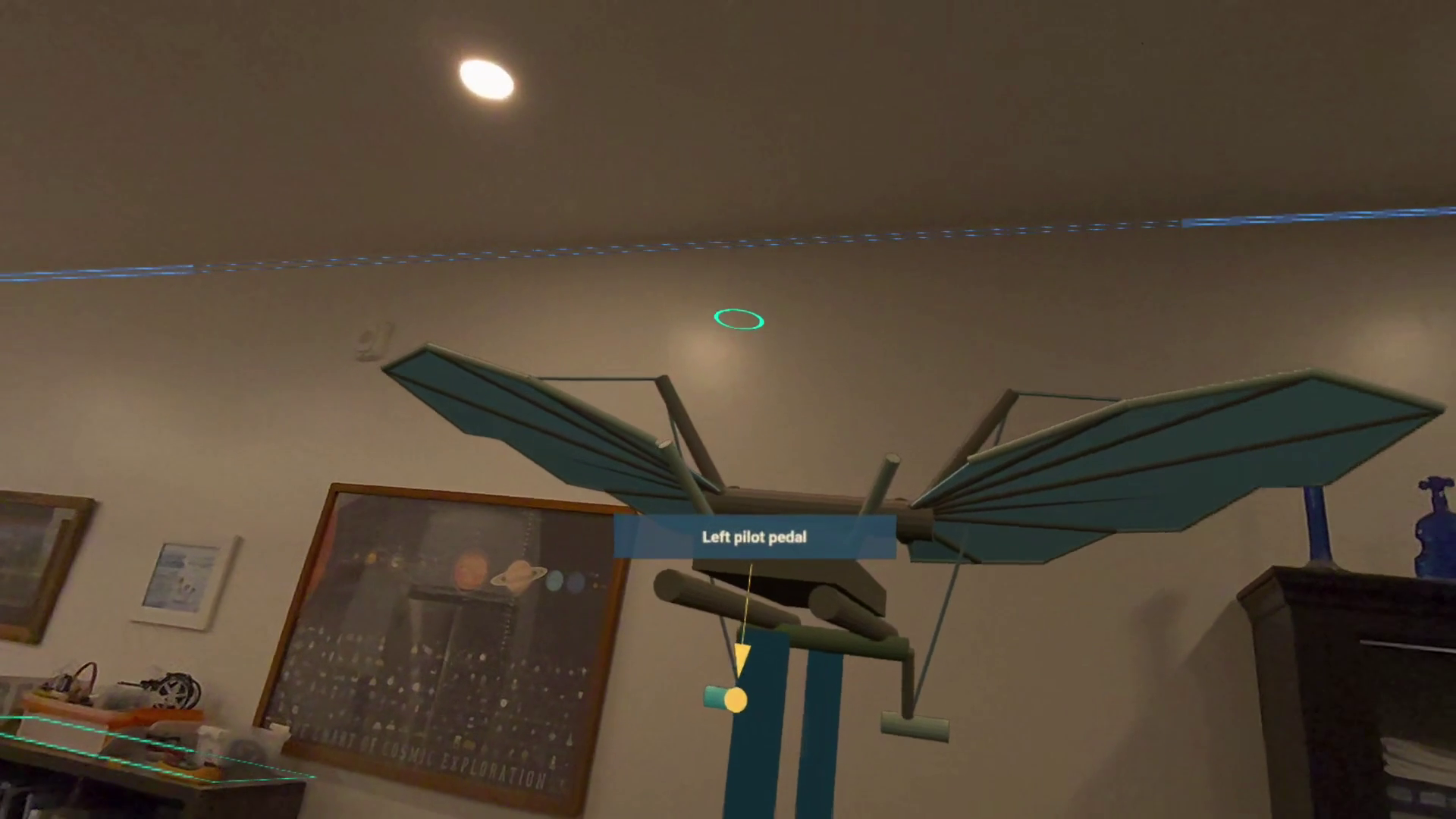
The 7:53 edit opens with the learner’s question and Blender request, then shows Leonardo with the aerial screw and ornithopter. Dyson-swarm and Faraday examples show the original voice route. Later examples use GPT live voice with the Decisions API, ending with the full Tesla conversation.
The labels identify two implementations recorded in different sessions. They are not a controlled latency comparison. The current release also includes optional practice, quizzes and saved learning progress; those features are not all shown in this video.
Teaching state and world state work together.
School keeps the teacher, conversation and learning record. Matrix handles the world, XR interaction and accepted scene changes. A host PC coordinates the Operator and authoring tools; Blender can produce models and animation, exported as GLB assets with identifiable parts.
This is a PC-hosted WebXR system used through Quest Browser. The engineering work includes asynchronous creation tasks, embodied voices and avatars, selected-part context, interruption handling, persistent conversations and world restoration.
An idea developed over several years.
- 2020 · Cosmos inspiration
The Pavilion of the Searchers imagined personal conversations with great scientific thinkers. That invitation to ask freely became the original inspiration.
- 2024 · First web prototype
A historical-persona question-and-answer experience, built for the Gemini API Developer Competition.
- 2025 · Spatial inspiration and early worlds
Ryo Suzuki’s “Augment Human Thought and Creativity with the Power of AR and AI” colloquium helped shape the direction. A Horizon Worlds museum explored embodied historical guides and was submitted to the Meta Horizon Creator Competition: Open Source Champions.
- 2025–2026 · Alpha, beta and learning experiments
Successive prototypes explored mentor conversations, goals, quests, assessment and persistence, followed by broader and text-first V2 experiments.
- September 2026 · Matrix Loading Operator
The previous class project developed the spatial creation foundation: voice requests, editable objects, Blender assets and saved worlds.
- October 2026 · Embodied learning on Quest 3
The Professor integration connects teachers and exhibits, followed by optional GPT live voice, Decisions-based pointing, practice and linked world/conversation restoration.
Explore the earlier source repositories
Report, presentation and development record.
These are the latest Cosmos revisions prepared for the October 27, 2026 demonstration. The report and slides credit Matthew Topham and GPT-6.1 Sol as AI co-author. The development record preserves the reviewed release and pull-request history through rc.7.